Refine your footage
What a folder of footage becomes.
You point us at a folder. We run every clip through the line, turn away anything that fails with a plain reason, hold anything a person has to decide, and push the rest to your bucket with a file list you can check. Nothing leaves until the checks are green and someone has signed.
The line
Every clip, accounted for at every step.
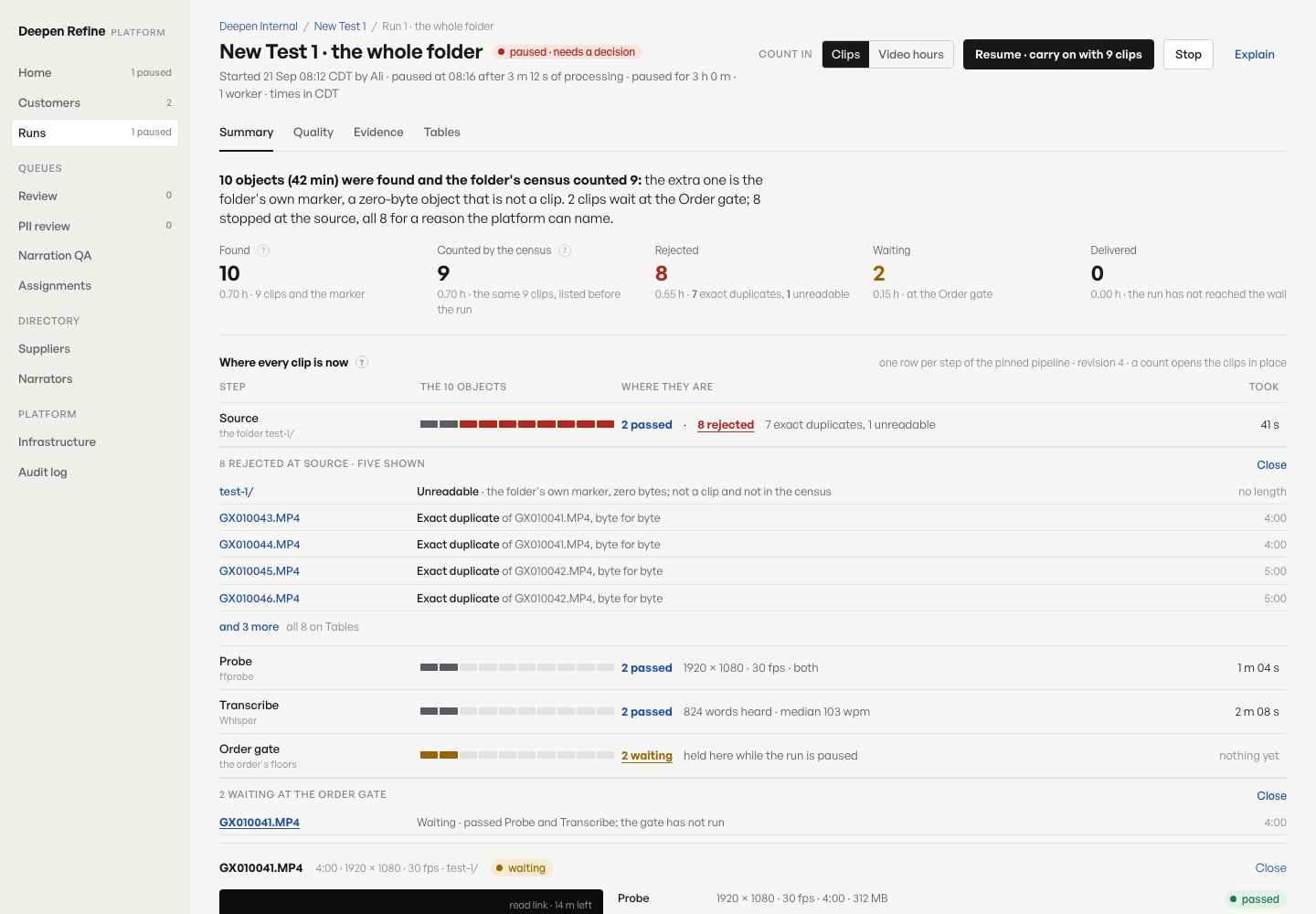
Your run page shows where each clip is, step by step: what passed, what was turned away and why, and what is waiting on a person. A clip is never lost between steps and never quietly dropped.
The gate
Nothing is pushed until the gate is green.
Before a delivery leaves, the platform runs its readiness checks and writes the result into the run's record. A check that cannot run is red, not skipped. A red gate stops the run and names the reason; a person decides, never the platform, and nothing is charged while it waits.
The last check is a person: a sample of the delivery is reviewed and signed before the push.
Six things that used to be six vendors.
Pick one to see what it does.
Every clip, checked against your order.
Resolution, length, sound, duplicates, how much of the clip is narrated, whether the camera is on the person doing the work. Anything that fails is turned away with the reason.
Your camera team sees the same reason you do.
Sorted into your categories, balanced to your order.
Every clip is labelled with one of your categories. Duplicates and off-topic footage are set aside. You see coverage against what you ordered while the batch is still running.
A category running short is known early, not at delivery.
Faces and screens removed.
Every face blurred, on every frame. Screens and paperwork that could be read are caught. Anything the detector is unsure about, a person decides.
Nothing ships on a guess.
Searchable, word-timed transcripts.
Every word carries a timestamp, so you can search the whole dataset by what was said and when.
A silent clip is turned away, not given a transcript.
0:00I am soldering component onto the green circuit board carefully. I set down my soldering iron and adjust my sitting position.
0:11I pick up the soldering iron again to continue working. I apply solder to the joint and hold it steady.
Narration by AI, by people, or both.
First-person, present-tense narration of what is happening on screen. Written and voiced by AI, in pilot now. Voiced by people, or done by people start to finish, by arrangement. Your choice per order.
Every script is checked against the picture before it is voiced.
Narrators record against the picture.
In the browser, against the clip as it plays, with the line paced to what is on screen.
Nothing to install.
The delivery
See everything. Ask nothing.
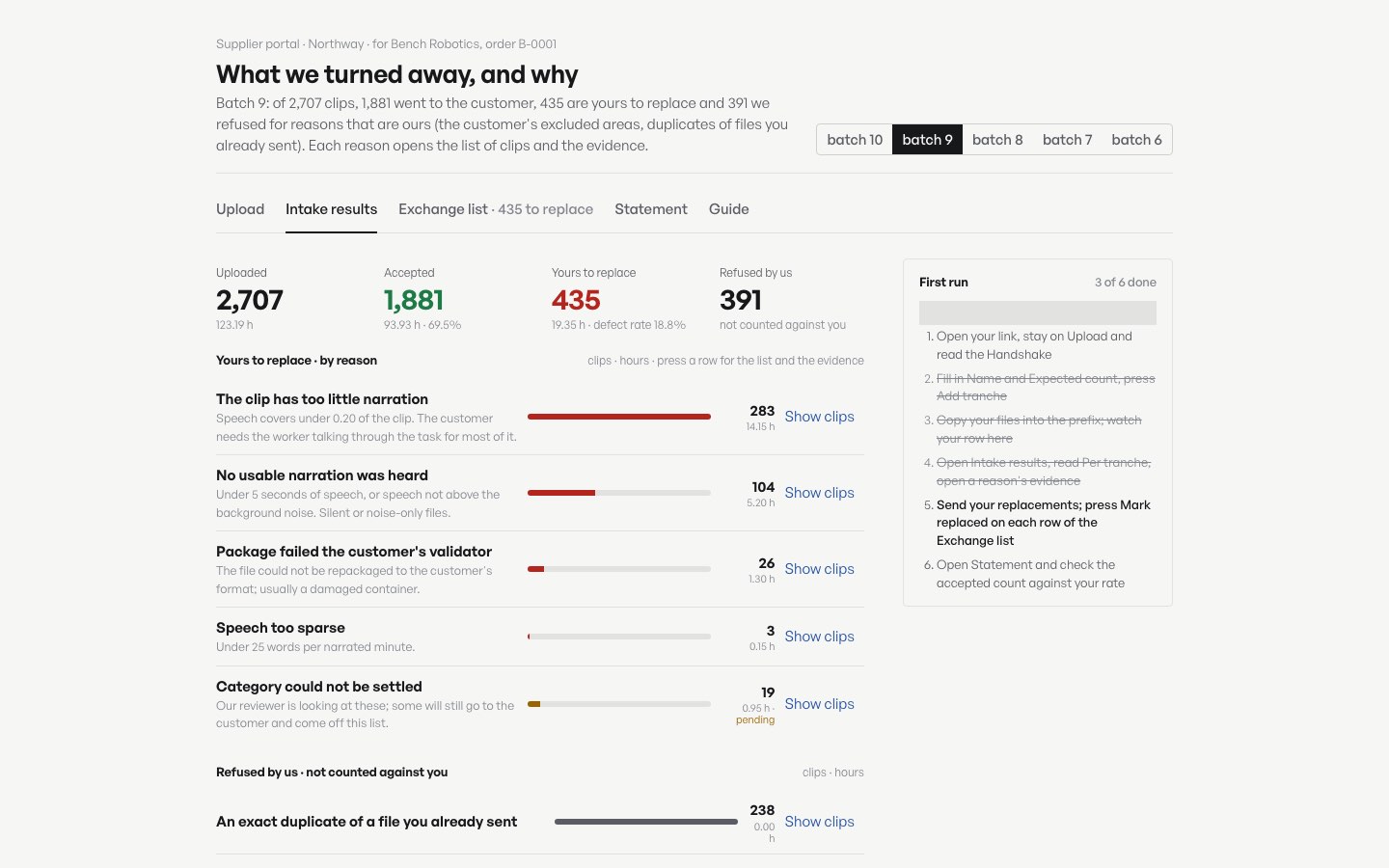
Suppliers see what was accepted, what was not, and why, and upload the replacements in the same place. Buyers see what was delivered and what they are being billed for, down to the clip.
We measure what we run. Every model behind the pipeline is measured on our own first-person footage before it touches yours, and the results are published on benchmark.deepen.ai.
Built and run by Deepen AI, which has supplied annotation and data infrastructure to robotics and autonomous-vehicle teams for years. Deepen Refine™ is that experience applied to first-person video.
About Deepen AISend footage. Sign for a dataset.
Tell us what the footage is and what the dataset has to be. We write it up as an order, you sign it, and we run it. Already working with Deepen? Sign in to your portal.